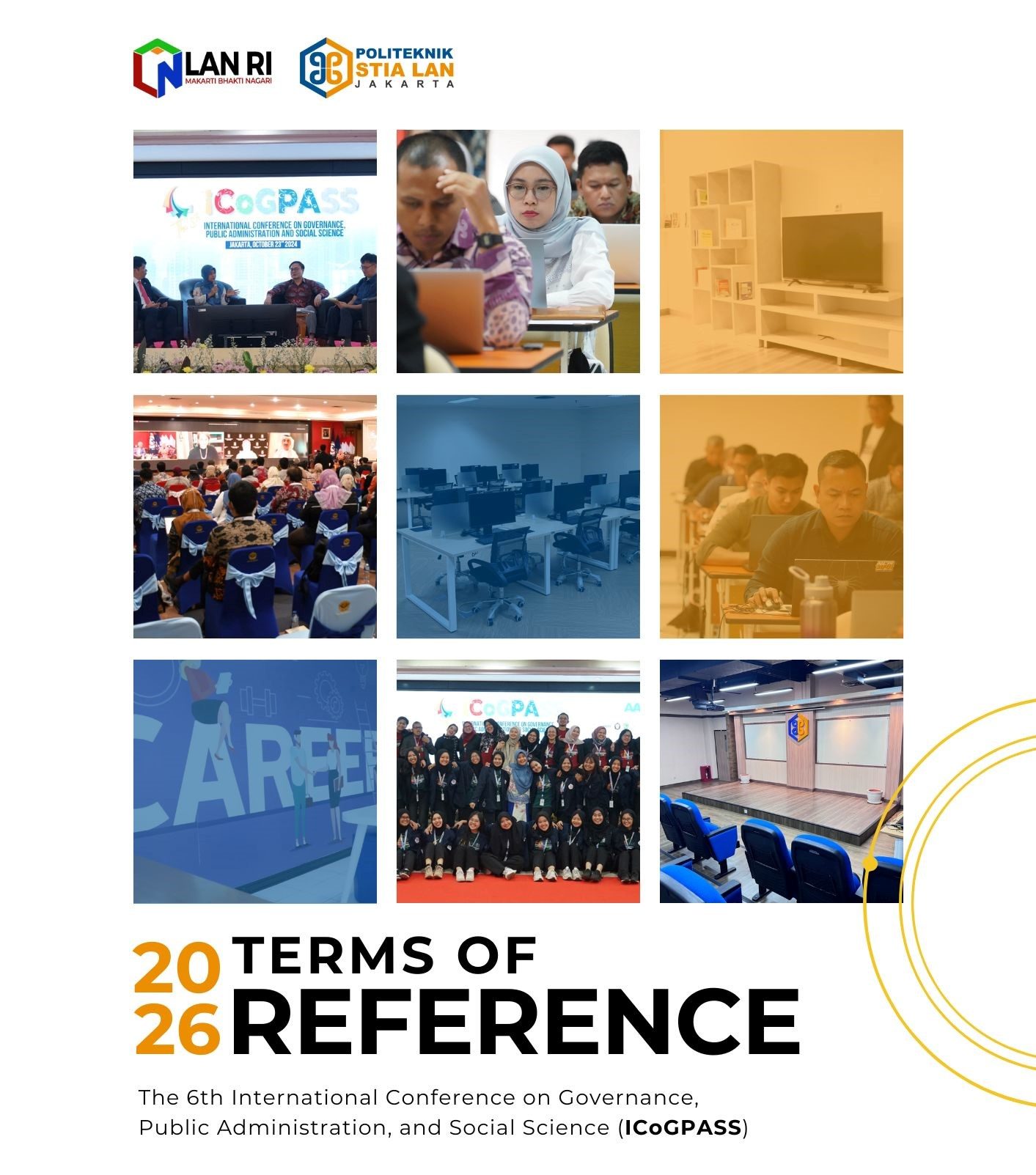
The National Institute of Public Administration (NIPA) School of Administration Jakarta is pleased to announce the 6th International Conference on Governance, Public Administration, and Social Science (ICoGPASS) 2026. Since its inception, ICoGPASS has established itself as a premier platform for academics, practitioners, policymakers, and professionals to exchange knowledge, share research findings, and collaborate on solutions that shape the future of public administration.
Building on the success of the 5th ICoGPASS 2024, which focused on “Resilient Global Governance: Nurturing Equal Development Policy, Human Resource Management, and Public Sector Economics Amidst the Uncertainties,” the 2026 conference addresses an even more urgent imperative: the fundamental values that must guide governance in times of profound global turbulence.
As we approach 2026, governments worldwide face unprecedented challenges: strained democratic institutions, economic volatility, climate emergencies, technological disruption, and persistent poverty. These challenges are not isolated—they interact, amplify, and cascade in ways that traditional governance approaches struggle to address. In this context, the core values of integrity, transparency, inclusiveness, and commitment to poverty eradication are not merely aspirational ideals—they are essential imperatives for effective, legitimate, and sustainable governance.
The 6th ICoGPASS 2026 provides a critical platform for examining how these four imperatives can be institutionalized, operationalized, and sustained across diverse governance contexts. This conference aims to generate practical insights, innovative frameworks, and evidence-based recommendations that can guide public administrators, policymakers, and citizens in building governance systems that truly serve all people.
Conference Theme
Governing for All: The Imperatives of Integrity, Transparency, Inclusiveness, and Poverty Eradication Amidst Global Turbulence.
The 2026 theme recognizes that effective governance in turbulent times requires an unwavering commitment to four foundational imperatives:
- Integrity
In an era of declining confidence in government, integrity in public service is not optional, it is imperative. This encompasses anti-corruption measures, ethical leadership, professional standards, and accountability systems that ensure public institutions serve the public interest.
- Transparency
The cornerstone of democratic accountability and informed citizenship. Transparent governance enables citizens to understand, monitor, and participate in decisions that affect their lives. From open data and fiscal transparency to algorithmic accountability, transparency must be embedded across all government operations.
- Inclusiveness
The prerequisite for legitimate and effective governance. Inclusive governance ensures that all voices are heard, all communities are represented, and all people have access to public services and participation in democratic processes. This is essential for social cohesion, equity, and sustainable development.
- Poverty Eradication
Persistent poverty is both a governance failure and a fundamental injustice. Eradicating poverty must be a central priority of public administration, requiring integrated policies, adequate resources, and sustained commitment across all levels of government.
The conference situates these imperatives within the context of “global turbulence” recognizing the multiple, interconnected challenges facing governance systems:
- Democratic fragility and institutional declines
- Economic volatility and fiscal constraints
- Climate emergency and environmental crises
- Technological disruption and digital transformation
- Social fragmentation and rising inequality
- Geopolitical instability and international disorder
- Public health threats and pandemic preparedness
Workforce transformation and organizational change
Conference Objectives
The 6th ICoGPASS 2026 aims to:
Advance research and knowledge exchange on governance imperatives. The conference provides a platform for scholars, practitioners, and policymakers to share findings, perspectives, and innovations that shape contemporary governance debates.
- Promote multidisciplinary and cross-sector dialogue. By bringing together diverse fields within the social sciences, public administration, and development studies, the conference encourages integrated approaches to complex governance challenges.
- Build institutional and professional capacity for values-based governance. Sessions, workshops, and conferences equip public administrators, researchers, and emerging leaders with tools, frameworks, and competencies to operationalize integrity, transparency, inclusiveness, and poverty reduction.
- Generate actionable policy recommendations for reform and practice. Discussions and research outputs aim to bridge the gap between academic analysis and real-world policy solutions, informing reform agendas at national, regional, and global levels.
- Strengthen international networks and collaborative partnerships. The conference fosters long-term cooperation among institutions, researchers, and organizations from all over the world for joint research, capacity-building, and knowledge transfer.